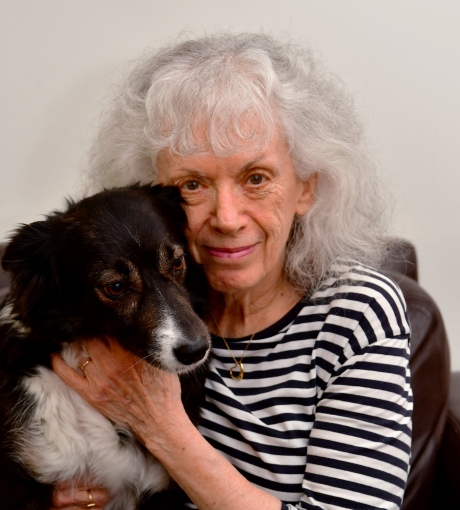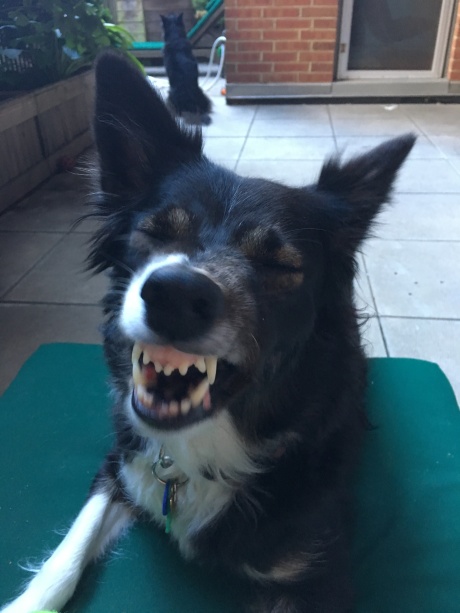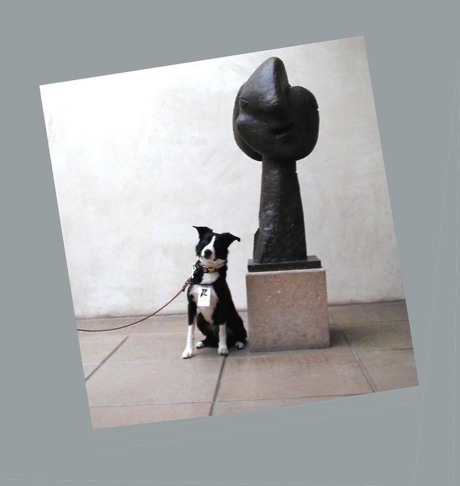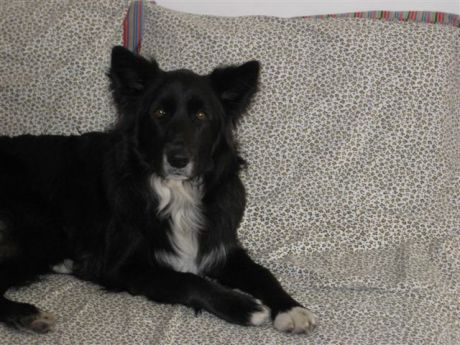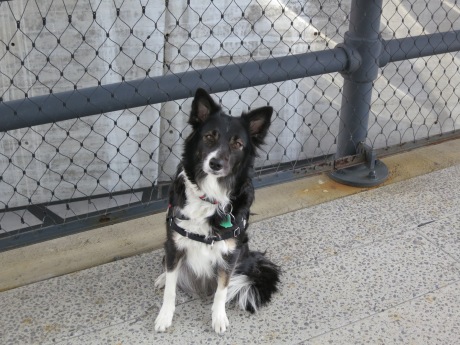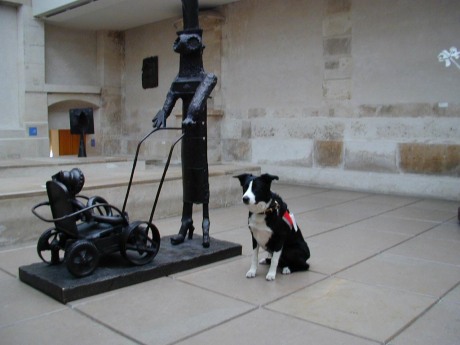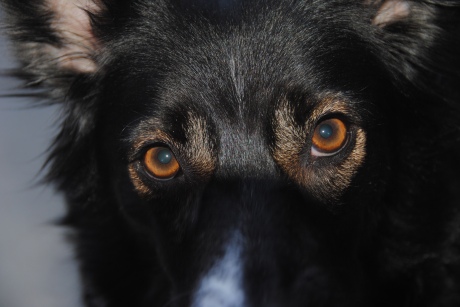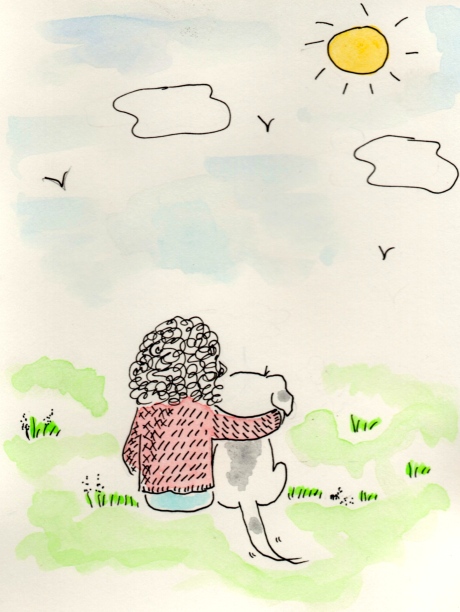
Sky and I were walking on the High Line yesterday, enjoying the early blooming flowers, the view of the Hudson River and the chance to be doing something fun together.  Right after passing a couple going north, as we were, I heard the man say, “Border collie.  Better keep in a straight line.”

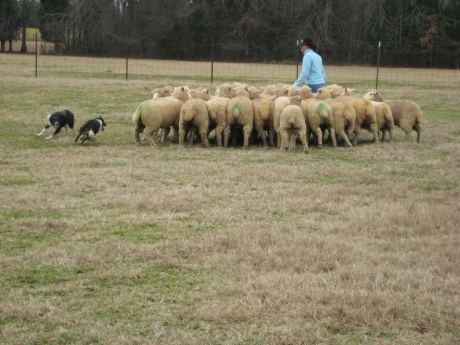
Funny?  Yes.  Silly?  That, too.  Border collies with jobs do not herd people.  The Border collie is just a blue collar bloke that needs a job.  Give her one, not necessarily working with sheep, and she’s as normal as the next dog.

Well, almost.

She will still spend an inordinate amount of time thinking, trying to figure out how to do her job better than any other dog on earth, thinking of ways to be useful, clever, funny, comforting, amazing.  She will work hard, play hard and sleep hard.  But, trust me, she will not herd humans.  That’s an act of desperation when she’s unemployed, because what’s her choice?  She can’t hang out at the local pub drinking beer and cursing her fate.  She can’t go back to school, unless someone takes her.  And there’s no use waiting on the unemployment line because she can’t endorse her check.

There are lots of ways to keep your smart dog’s mind and body occupied, to make her feel she’s a useful dog.  Figuring out which ones to teach, well, that’s your job.


Give a hug to someone you love…

Sky and I met two really nice ladies on the High Line today.  Looking at Sky, one of them said, “Border collies are always thinking, aren’t they?”  I said, “Yes.  At least that’s the way it seems to me.”

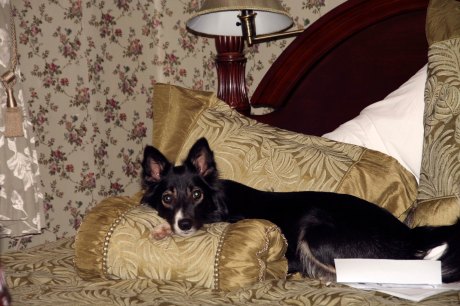
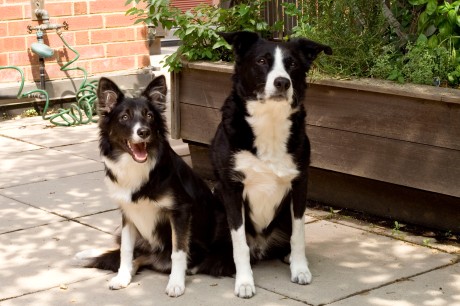
We talked about other breeds that were super smart and about dogs we’d had and about the views from the High Line and where she and her friend might eat lunch.  I had my little camera with me, the point and shoot one I usually carry, but I didn’t take any pictures today.  So many of my pictures are just snapshots of Sky, Sky on the High Line looking at me, Sky at the gym looking at me, Sky walking along the river looking at me, Sky in the grass looking at me.

When I got home, I began to look at some of the snapshots I’ve taken of Sky, wondering if, in fact, she was always thinking, wondering if she was taking her own snapshots of me, mental images that told her how I was feeling and whether or not I needed her help at a given moment, images that helped her to understand me better, to understand us better.  I looked for a long time, at snapshot after snapshot, realizing that we are both always thinking and that a lot of the time, we are thinking about each other.

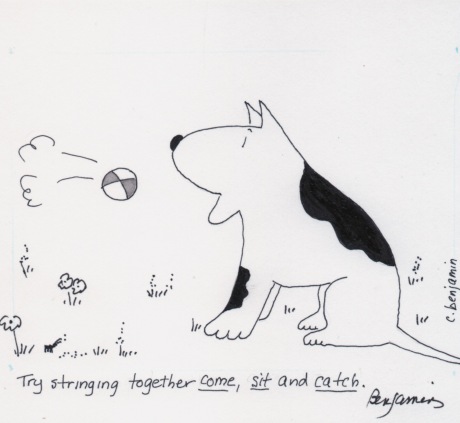
First, play a favorite game with your dog indoors.  Next, to let him know he’s about to begin working, do a sit stay.  Then perhaps one more in another room.

Now, using a four or six foot leash and a plain buckle collar, take your dog out and let him relieve himself.

Then do one more sit stay, outside.

Now you are ready to teach your dog to heel.

Nevermind.


Do you remember the first time you heard a story on the news which said that an elderly person was hit and killed by a hit and run driver on such and such a street and it turned out that the elderly person in question was fifteen years younger than you were?

Nevermind.  There are some good things about getting old.  Obviously, it beats the other selection.  And once you get old, you are no longer trying to find yourself.  You are too busy trying to find your keys or your glasses.  You’re also good to go at any moment without needing pesky contraceptives, assuming you remember what goes where.

Best of all, you can still have a dog.  But the dog will need a godparent, someone who would either adopt and love your dog after you are no longer around to do so yourself or, if that’s not an option, would find your dog another loving home.

To facilitate this, it would be good to choose an easy dog rather than a difficult one, a pure-bred dog or mixed breed that’s easy going, affectionate, friendly but respectful, not too big for you to handle, not too difficult to groom, not so energetic that you can’t keep up.  (We are not going to discuss my choice of a Border collie.  Every rule has its exceptions.) And it would make sense all around for your dog to be well-trained. It would be kind of a dirty trick to leave someone a dog who will pee on his rug, chew his shoes and bark all day if left alone.  If training is not something you can do on your own, a good book (I have a new one coming out very soon) or a local training class will help enormously.  If you can, you might also open a modest savings account in trust for your dog’s godparent so that there’s a little dough to help with the expenses of taking on another family member.  And last, but important, the name of your dog’s godparent should be included in your will.

There are some not so good things about getting old, for instance, oh, who remembers?  But if you can still have a loving, cheerful dog to cuddle with at night and play with during the day, if you can still have a ready anytime you are companion to inspire you to walk more, to laugh more and to feel needed, this is a good thing, a very, very good thing.  Even if you are very, very old, life is good when you share it with a dog.


Years ago, when my first mystery book, This Dog For Hire, came out, I went to my first mystery convention.  I never went anywhere without Dexter, my service dog, and I didn’t go to the convention without him either.  But his presence caused a great, big stir.  I clearly wasn’t blind, so why on earth did I need a service dog?

On the second day, my editor told me what people had decided – that Dexter was a stroke prevention dog!  “Have you had a stroke since you got here?” he asked.  I shook my head no.  “See!” he said, a wry smile on his face.  “It’s working.”

The idea of using a service dog to prevent something is not unique.  Probably the most well known of the prevention dogs is the seizure alert dog, worth his weight in gold.  (I created a fictional one in a later mystery called The Wrong Dog, and met a real one while doing research for the book.)   In this case, a seizure can be prevented or minimized because the dog alerts and the person knows to take medication.

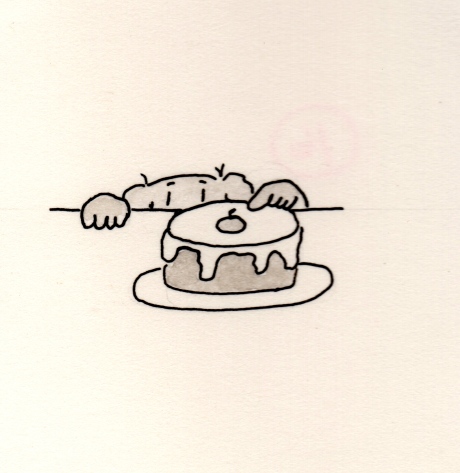
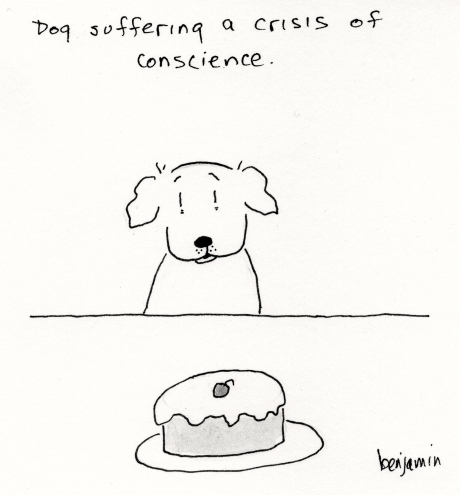
Right along with other areas where service dogs help disabled people to be out in the world rather than stuck at home, the concept of prevention dogs is growing, too.  In fact, two of my friends are interested.  One wants an ice cream prevention dog, the other a cookie prevention dog.  The diet is so yesterday!

Alas, at this time, ice cream and cookie prevention dogs are not considered legal.  Giving in to temptation is not considered a disability.  Not yet, anyway.  Patience, dear friends.  When Dexter and I began to leave the comfort of Greenwich Village, where whatever seems to be the attitude, Crohn’s disease was not on anyone’s list of legal disabilities either.  We were yelled at in airports.  Taxi drivers astutely noticed that I wasn’t blind and refused to take us.  And the owners of several restaurants refused to give us a table, one charmingly saying, “I don’t give a damn what the law says, I’m not having a dog in my dining room.”

Things are better now and even if the world is not yet ready for the ice cream prevention dog, it has become more ready for and more hospitable to dogs who help people with disabilities to be productive members of society.  And that’s something worth celebrating, perhaps with a nice cookie and a bowl of ice cream.


If you pay attention to your pup, you will know almost everything you need to know about house training.  You will see exactly how long after she eats or drinks she needs to relieve herself and you will see how long she can run around and play indoors before needing to relieve herself again.

Never punish an accident.  But do take your puppy right out to remind her where she’s supposed to go.  And do clean up quickly and well.  By reminding the dog frequently where it’s good to go and by keeping the indoors clean, you will be teaching your puppy a lesson that will stand her in good stead for all of her life.  Neatness counts.  It’s linked to good health.  It’s linked to survival.

You can help speed house training by teaching your dog to sit when you ask her to.  Teaching the sit, or better still, the sit stay, teaches your puppy how to listen and learn.  It puts a different spin on the words you say to her, words that are not a part of her natural language but which, she will discover, she can learn to understand.

Take a favorite toy, hold it over the puppy’s head so that she needs to look up to see it, say “sit.”  As soon as the puppy sits, give her the toy.  Once she catches on, ask your puppy to sit before putting down her food dish or offering her a treat.  And remember that while house training should be reliable by the age of six months, education should take forever.  With education, it’s not only the product you are after, it’s the process, time spent with your dog during which you both learn more about each other while accomplishing something fun and perhaps useful at the very same time.

Because sometimes, after you rescue them, they rescue you right back.


I’ve always given the birds in our city yard bread.  I love looking out the window and watching them swoop down to the table where I have put out a fabulous spread for them, plain bread or sometimes bread with peanut butter to fatten them up for the winter.  The other day, as a treat for the new year, I bought them wild bird seed and put that out, with some torn up bread, and ducked back inside to watch them feast.

Birds arrived by the dozens, making me wonder how they knew.  Looking at the table, I thought I had put out enough food for the winter, but by late afternoon, there wasn’t a seed left and there was nary a sparrow to be found.

When I got up this morning, the yard was full of waiting birds.  If they had little hands, they might have been patting their stomachs to let me know they were hungry, to criticize me for sleeping so late.

So what does “bird brain” mean?  My little friends always show up when I put out food and since, I have read, it is not a good idea to make wild things dependent on you by feeding them every day, I don’t.  Still, random meals get immediate attention.  If the dogs need to go out, the birds repair to higher ground, the dogwood tree or the top of the fence that divides our yard from the next one.  Even if you show up on the other side of the window, the movement may send the birds flying.  And when it rains, they stay inside in the little boxes formed by the brick basketweave fence that separates our yard from the park in front of it. In other words, their survival instincts are excellent.  In other words, city sparrows with bird brains are very good at being birds.

What about dogs, I wonder.  When I worked as a dog trainer, as the CEO and janitor of my own one person business, clients would often tell me their dogs were dumb.  My job at the first visit was always to show them how untrue that was.  In that case, it meant teaching a dog the sit stay.  Now I think about other kinds of canine cognition.  Now I think about how well or poorly different dogs are at being dogs, how they communicate to others of their own kind and to our species as well.  I wonder what it means that some dogs seem to understand not merely words but sentences, that some know what we are feeling, that they know when we are in pain and try to do something useful in response.

I’m sure some dog owners still think their dogs are dumb when in most cases what they are seeing is the result of their own inability to communicate.  Some may think their dogs have bird brains and are only interested in the day’s menu and in staying out of the rain.  But there’s so much more there and the more we focus on trying to understand, the more fascinating this, and every, relationship becomes.

I have to remember that my mom watches me a lot of the time, so when I want to misbehave, I should do it when she’s otherwise occupied so that she always maintains a ridiculously high opinion of me.

Happy New Year fellow dogs!


Follow

Get every new post delivered to your Inbox.

Join 30 other followers